
Course Description:
This 14-hour course is designed to give the learner a good understanding of the practical applications of treating and managing difficult, however common, conditions in the general population. These conditions include but not limited to: Osteoarthritis, Labrum tears, joint restrictions, hip Adhesive Capsulitis, knee injuries, Metatarsalgia, Hallux Valgus, Tibialis posterior tendon weakness and tendinopathies, Plantar Fasciitis and Morton’s Neuroma. Learn the theory and application of End Range Loading Techniques, nerve tension and joint mobilizations. This is to improve range of motion, balance, proprioception, and nerve function, to reduce pain and increase functional activities. All this is incorporated around patient centered care.
Objectives:
The participant will be able to apply/manage/treat/discuss…
- The indications and contraindications and safety with the application of said techniques for the patient and therapist.
- Principles in applying End Range Loading, Nerve Tensioning and Joint mobilizations.
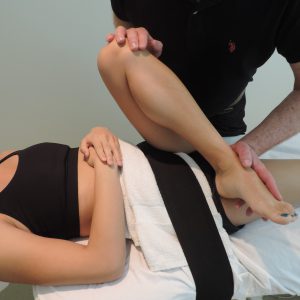
- Proper instruction on how to use a mobilization belt
- Quick methods of assessment for the lower extremity, to include Active and passive assessments.
- Perform reflex testing, grading and its clinical significance.
- Assess for leg length discrepancy using multiple methods for reliability.
- Perform assessment and function of the ankle and feet.
- Joint mobilization for the hip, knee and foot
- End range loading for the hip, knee and foot.
- Nerve tensioning for the lower extremity
- Discuss and treat common conditions a massage therapist sees for the lower extremity.
- Discuss/Practice patient centered care, and its clinical significance.
Locations:
Red Deer
June 6-7th, 2026
New Westminster
September 19-20th, 2026
Vernon
October 3-4th, 2026
Victoria
September 12-13th, 2026
Included: Coursebook on techniques, Pizza, and Salad Lunch (day one)
What is End Range Loading Therapy or Techniques?
End Range Loading Techniques (ERL) is essentially taking tissue (nerves, tendons, discs, connective tissue) into a position of tension and then applying an overpressure to stretch and/ or glide the affected tissue to assist with improved function and reduced pain.”
painproclinics.com 2014